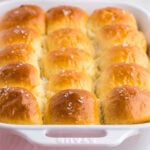
Parker House Rolls with Honey Butter
I made these Parker House rolls from scratch and brushed them with a delicious honey butter as soon as they came out of the oven. They were so good!
Servings: 15
Equipment
- 9x13 baking dish
- Electric mixer or can knead by hand
Ingredients
- 3 ¾ cups Bread Flour (spooned and leveled)
- ¼ cup Sugar
- 2 ½ teaspoons Instant Rise Yeast
- 1 ¼ cup Whole Milk at room temperature
- ¼ cup Salted Butter (softened and divided into 4 portions)
- 1 Large Egg
- 1 Large Egg Yolk
- 4 tablespoons Salted Butter melted
- 2 teaspoons Kosher salt
- flakey sea salt for garnishing to taste
Egg Wash
- 1 large egg
- 1 teaspoon water
Honey Butter
- ½ cup salted butter room temperature
- 2 tablespoons honey
- 2 tablespoons confectioners sugar
Instructions
To make the dough
- In a large mixing bowl of a stand mixer, mix together 3 ¾ cups bread flour, ¼ cup of sugar, 2 teaspoons of Kosher salt, and 2 ½ teaspoons of rapid rise yeast. (Check notes if you don’t have rapid rise yeast).
- Add in 1 ¼ cups room temperature whole milk, 1 large egg, and 1 large egg yolk.
- Using the dough hook attachment of the stand mixer, mix the ingredients together on medium-low speed until it comes together into a ball, about 1 minute. Turn the mixer up to medium speed and add the softened ¼ cup butter in 4 intervals allowing the butter to be incorporated into the dough before adding the next portion. At this point the dough should not be sticking to the sides or bottom of the mixing bowl. If the dough is sticking add 1 tablespoon of flour and let it get fully incorporated before determining if more flour needs to be added (see notes).
- Once all combined, continue kneading in the stand mixer for about 10 minutes on the medium setting.
- Transfer the ball of dough to a lightly greased bowl. Cover with plastic wrap and allow it to sit at room temperature to rise until it has doubled in size. This time will vary depending on the temperature and humidity of your home, but most likely 1 hour to 1.5 hours.
- While dough is proofing, grease a 9x13 pan with butter and set aside.
- When the dough has doubled in size, punch down the dough and then place the dough onto a lightly floured work surface or a silpat (silicone mat). If you have a scale, it is ideal to weigh the dough to determine the weight each bun will need to be. Divide the dough into 15 portions about 64g each. Keep portions covered with plastic wrap while working to prevent them from drying out.
- Melt 4 tbsp of salted butter in a small bowl and set aside.
Shaping the Rolls
- Work with one piece of dough at a time. Using your fingers, gently press it into a rectangle about 5 x 2.5 inches.
- Brush some melted butter onto the top of the rectangle, leaving a ¼-inch border around the edges unbuttered (see notes). Set aside the remaining butter—this will be used later for brushing the tops of the baked rolls.
- Fold the rectangle almost in half, so one end of the unbuttered edge stays exposed. Holding the folded dough in one hand, use your other hand to gently stretch the unbuttered edge outward, then fold it into the center. Press it down firmly with your finger to help seal it.
- Rotate the dough slightly (about 45 degrees), stretch a new edge, and fold it into the center, pressing firmly again. Repeat this process (rotate, stretch, fold, and press) about three times. This helps shape the dough into a smooth, taut ball. If needed, pinch the bottom to help it seal.
- Lastly in forming the bun if the shape needs a little work, place the dough ball on the work surface (seam side down) and using your cupped hand roll the dough ball gently until it has a nice shape. Place in the greased 9x13 pan seam side down (see notes).
- Keep the buttered 9x13 pan covered with plastic wrap while getting all 15 rolls into the pan. Once filled, Let the rolls rise one more time at room temperature for about 45 minutes so they can puff up a bit and are touching each other? Thirty minutes into this second rise, preheat the oven to 350F.
- Prepare the egg wash by whisking together one egg and a teaspoon of water.
- Once the rolls have finished rising the second time, remove the plastic wrap and brush the tops of the rolls with the egg wash. Place the pan on the middle rack of the oven and bake for 20-30 minutes. The tops should be golden brown. Depending on your oven you may want to rotate the pan halfway through baking to get an even browning. You can also insert a thermometer into one of the buns to check to see if they are done, it should read 190F.
- Remove from the oven and brush on more melted butter and sprinkle with flaky salt.
- Allow the rolls to cool in the pan for about 20 minutes before serving warm.
Making the Honey Butter
- While the rolls are cooling make the honey butter.
- In a small mixing bowl add in the ½ cup room temperature butter, 2 tablespoons honey, and 2 tablespoons confectioner’s sugar. Blend together with your mixer at medium/high speed until the mixture becomes smooth and creamy. Remove honey butter to a serving dish of your choosing.
Notes
What if I don’t have Instant yeast, but I do have dry active yeast, can I use it? Yes, you can, but you will need to modify the steps slightly. In a small bowl add ¼ cup warm milk (from the total milk being used in the recipe) (around 100-110F), 2 tablespoons of the sugar used in the recipe, and 2 ½ teaspoons of the dry active yeast. Allow it to sit for about 5 minutes or until it becomes frothy and foamy. If it doesn’t become foamy within 5-10 minutes, the yeast is probably too old and needs to be discarded. At this point you can add the frothy mixture into the stand mixer with the dry ingredients and add the rest of the wet ingredients and continue with bringing them together on medium low speed.
Can I skip brushing the dough with butter before forming the roll? You can skip this step and the results are still very good. It does make it easier to form the dough into a nice tight ball, but traditionally Parker House Rolls do add butter during this step.
IMPORTANT:
- Do not add too much flour, or you will end up with a dry dough and a dense roll. The dough is somewhat sticky but shouldn’t be sticking to the bowl while it is being kneaded. Only add flour 1 tbsp at a time to prevent sticking.
- Leaving a ¼” unbuttered edge around the rectangular pressed out dough makes it easier for pinching the dough together to form the bun. If there is butter where you are trying to pinch the dough, the dough will struggle to stick to itself.
- When making the dough bun, don’t worry if the seam isn’t perfect. The bun will bake seam side down and you will not notice any minor imperfections.
- Do not overbake them or they will turn out dry!
Nutrition
Calories: 263kcal | Carbohydrates: 30g | Protein: 5g | Fat: 14g | Saturated Fat: 8g | Polyunsaturated Fat: 1g | Monounsaturated Fat: 4g | Trans Fat: 0.5g | Cholesterol: 58mg | Sodium: 401mg | Potassium: 76mg | Fiber: 1g | Sugar: 7g | Vitamin A: 444IU | Vitamin C: 0.01mg | Calcium: 37mg | Iron: 0.4mg